Free AC Inspection for Paradise Valley Home Buyers
Paradise Valley homes routinely run two to four AC systems across the main house, casitas, guest wings, and pool houses. A general home inspector budgets 10 to 15 minutes for the entire HVAC scope, the same time they would spend on a one-system tract home. We fully disassemble each unit, verify refrigerant on every system, test capacitors, and give you a written report you can take straight into the negotiation.
🏠 100% Free, No-Obligation · Multi-System Reports · Licensed ROC #362677
What a Standard Home Inspector Won't Tell You About Paradise Valley AC Systems
General inspectors cover the roof, plumbing, electrical, and HVAC in 3 to 4 hours. A PV property with three or four separate AC units gets the same single HVAC line item as a 1,800 square foot ranch. That is not enough evaluation for $30,000 to $60,000 worth of equipment running across multiple wings of the house.
Surface-Level vs. Full Multi-System Teardown
A general inspector turns each thermostat on, confirms cold air, and moves on. We pull covers on every condenser, remove access panels on every air handler, and physically inspect components inside each unit. On a four-system PV estate that means four separate teardowns, not one walkthrough. If there is a failing capacitor in the casita unit or a slow refrigerant leak in the guest wing system, we find it.
No Refrigerant Check vs. Per-System Measurement
Most general inspectors note "refrigerant not verified" on the report because they do not carry calibrated gauges. In a multi-system home, that is a guess across multiple compressors, any one of which could be low. We test charge on every unit with manifold gauges. Low refrigerant on one wing's system means poor cooling, compressor strain, and an expensive repair the buyer inherits.
No Electrical Testing vs. Component-Level Diagnosis
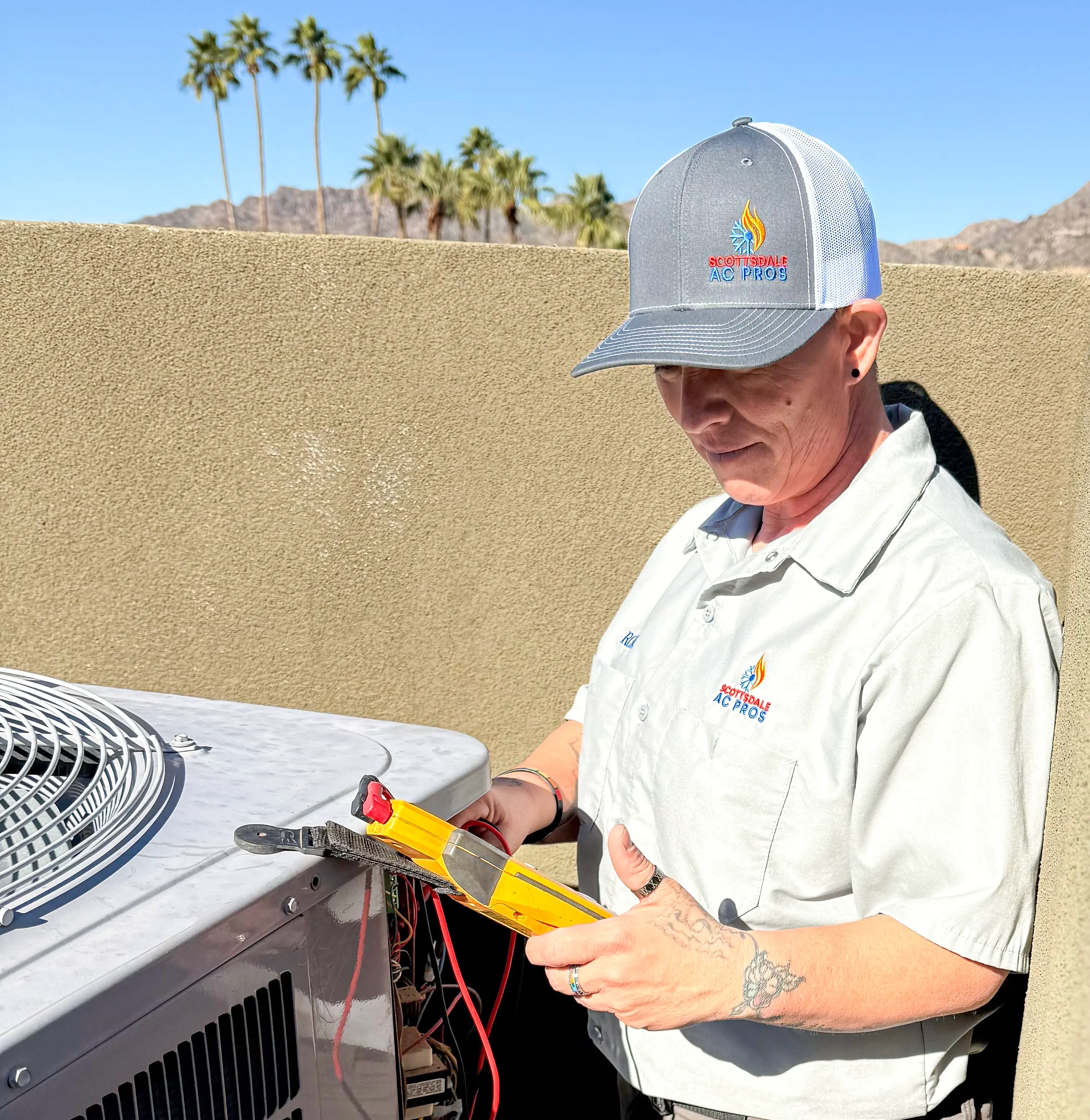
Capacitors are the first component to fail in Arizona heat, and they can test fine visually while running at borderline capacity. We test capacitors on every system with a multimeter, check contactor pitting on each unit, and inspect electrical connections across every disconnect. A 4-ton estate condenser with a weak capacitor can pass a visual check today and fail on the next 115-degree afternoon.
Vague Notes vs. a System-by-System Written Report
"HVAC functional at time of inspection" is not useful when you are negotiating a multi-million-dollar home. We give you a written report broken out per system: main house, guest wing, casita, pool house. Each entry includes age, component condition, refrigerant status, and recommended repairs with estimated costs. That report is a negotiating document, not a formality.
What We Check, System by System, Component by Component
We inspect every accessible part of every system on the property: outdoor condensers, indoor air handlers, mini-splits in casitas and pool houses, zone dampers, and ductwork in flat-roof attic spaces. This is the same inspection we perform on a paid multi-system tune-up. The only difference is the price.
Evaporator and Condenser Coils
Dirty or corroded coils are the single biggest efficiency killer in Arizona AC systems. We inspect both the indoor evaporator coil and the outdoor condenser coil on each unit for dust fouling, corrosion, refrigerant oil streaks (a leak indicator), and physical damage. Hillside PV condensers often sit downwind of native landscaping that packs grit deep into the fins, where a surface inspection never sees it.
Capacitors and Contactors on Every Unit
Capacitors store the electrical charge that starts your compressor and fan motors. Condensers on south- and west-facing pads in PV degrade fastest. We test each capacitor with a multimeter to get an actual microfarad reading and compare it against the spec rating, on every system. A capacitor reading at 70% capacity may still start the unit today but fail on the next 115-degree afternoon. We also inspect each contactor for pitting and carbon scoring.
Refrigerant Levels and Leak Indicators
We check refrigerant charge on every system using calibrated manifold gauges and inspect line connections, service valves, and coil surfaces for oil residue that signals a slow leak. Low refrigerant on a 4 to 8 ton system rarely causes a total failure during inspection. What it guarantees is declining performance and eventual compressor damage. On a multi-system home, finding one undercharged unit is common, and easy to miss without testing each one.
Blower Motors and Zoned Airflow
We check the indoor blower motor's amperage draw against its nameplate rating on each air handler, inspect the wheel for debris buildup, and measure airflow into each zone. A blower running at 110% of rated amperage is headed for motor failure. We also verify return air volume is adequate for the unit size, which matters for PV homes with great rooms, converted garages, or added wings that were not part of the original load calculation.
Condensate Drains, Pans, and Float Switches
Monsoon humidity from July through September creates conditions for drain line algae growth and water backup. In a custom PV home with stone flooring, plaster walls, and built-in cabinetry, a backed-up condensate line in an attic air handler becomes a five-figure water damage claim fast. We inspect each pan for rust and overflow staining, test every drain line for flow, and verify a float switch is present to cut power before water damage occurs.
Ductwork, Zone Dampers, and Insulation
We inspect all accessible duct connections at each air handler, check flex duct for collapse or disconnection at primary branches, verify zone dampers respond to thermostat calls, and look for insulation gaps in flat-roof attic duct runs where temperatures regularly exceed 150 degrees in summer. A well-functioning unit attached to leaking or poorly insulated ductwork is still an underperforming system, and a buyer who does not know about it inherits both the high energy bills and the repair cost.
You Get a Written Report. Take It Into the Negotiation.
After the inspection, we give you a written summary covering each system on the property: installation date, current condition by component, refrigerant charge status, and any items we would recommend repairing or replacing. The report is dated, signed, and formatted to share with your real estate agent and use during the negotiation or due diligence period.
Paradise Valley homes routinely carry $30,000 to $60,000 in HVAC equipment across multiple systems. A written report from a licensed contractor carries more weight in a negotiation than a general inspector's field notes. If we find a 14-year-old condenser on the guest wing nearing replacement, your agent can use that to request a credit. If everything checks out, you close with documented confirmation.
- ✓ Per-system written findings (main, guest wing, casita, pool house)
- ✓ Installation date and age confirmed on-site for each unit
- ✓ Refrigerant charge status documented per system
- ✓ Estimated repair costs for any items flagged
- ✓ Signed by a licensed HVAC contractor (ROC #362677)
- ✓ Ready to share with your agent or attorney
Why Paradise Valley Buyers Use a Dedicated HVAC Contractor
A general inspector covers the AC in the time it takes us to check one component on one unit. Here is what makes a dedicated multi-system inspection different.
Residential HVAC Only, Multi-System Experience
We work exclusively on residential AC. Our day-to-day work includes the same multi-system, zoned, and mini-split configurations common in Paradise Valley homes. Every technician on our crew spends their workdays diagnosing and repairing the same type of property you are about to buy. That focus matters when the job is spotting a problem on a guest wing condenser a generalist would never look inside.
Paradise Valley Specific Knowledge
We know the failure patterns of equipment installed during PV's 1990s and 2000s custom build boom. We know which hillside lots collect the most solar load on their condensers, which older systems are still running phased-out R-22, and which zoned setups routinely fail mid-summer. That context turns raw data into a useful assessment instead of a list of readings.
No Sales Pressure, No Upsell
This inspection is free. We are not here to sell you a service contract or push system replacements. If we find something significant on one of the systems, we tell you what it is and what it costs to fix. If every system checks out, we tell you that too. The goal is to give you accurate information, not a reason to call us back. Though we are happy to be the contractor you call when you move in.
Already Own the Home? We Handle Maintenance and Repairs Too.
If the inspection finds deferred maintenance, a needed repair, or you just want to keep multiple systems running long-term after you move in, we are the same crew. One call gets you the same technicians who did the inspection.
We cover everything from annual tune-ups for every system in your home to full AC repair and system replacement. No handoff to a different company, no restarting the relationship from scratch.
Schedule Your Free Paradise Valley AC Inspection Before You Close
We work around your escrow timeline and any access coordination through property managers or listing agents. Morning, afternoon, whenever the property is accessible. Call us or fill out the form and we will confirm within the hour.
Free AC Inspections Across Paradise Valley and the Valley
We schedule around your escrow timeline. We cover Paradise Valley, Scottsdale, Arcadia, Fountain Hills, and surrounding areas.
Areas We Serve:
Licensed, Certified & Trusted
Paradise Valley AC Inspection Questions from Home Buyers
The questions we hear most often from buyers under contract on Paradise Valley properties.
Is the inspection really free, even for a multi-system home?
Yes, completely free, regardless of how many systems are on the property. No service fee, no diagnostic charge, no obligation to hire us afterward. We offer this because Paradise Valley buyers who get an honest assessment tend to become long-term customers after they move in. That is on you, at your pace. There is no sales pitch during or after the inspection.
How long does the inspection take for a Paradise Valley estate?
A single-system home takes 60 to 90 minutes. A Paradise Valley property with three or four units across the main house, guest wing, casita, and pool house typically takes 3 to 4 hours. We schedule around the buyer's access window during escrow or the due diligence period and can coordinate directly with the listing agent or property manager if needed.
What if the inspection finds something wrong with one of the AC systems?
We document each finding in the written report with an estimated repair cost, broken out per system. Your real estate agent can then use that to request a repair credit, negotiate a price reduction, or ask the seller to complete repairs before close. In some cases the finding warrants walking away. Our job is to give you the information clearly so you can make that call.
Can you access gated PV communities for inspections?
Yes. We regularly work in gated Paradise Valley communities like Clearwater Hills, Finisterre, and Crown Canyon. When you book the inspection, share the gate access procedure (code, guard gate notification, or listing agent coordination) and we will handle the rest.
How is this different from what the home inspector already checked?
General inspectors run a functional test on each thermostat: they turn the system on and confirm cold air. On a multi-system PV property they typically log system count and visible age. They cannot measure refrigerant on each unit, they do not test capacitor microfarad values, and they do not pull covers on individual condensers. We treat each system like a standalone job, the full per-unit teardown they are not set up to do in the time they have.
How old is too old for a Paradise Valley AC system?
The national rule of thumb is 15 to 20 years. In Paradise Valley it is closer to 12 to 15, because systems here run roughly 2,000 hours per year against the national average of 1,200 to 1,400, and estate-sized units cycle harder against solar load through expansive glass. A unit installed before 2014 has passed the midpoint of its realistic desert lifespan. That does not mean immediate replacement, but it factors into your offer price. We tell you exactly where each system sits on that timeline.
Schedule Your Free Paradise Valley AC Inspection
Tell us the property address and when access is available. We will confirm within the hour.